
Korean listings use housing words that do not mean what you might expect. An “apartment” is a tower in a large complex, a “villa” is a modest low-rise building, and an “officetel” is legally an office you can live in. Knowing the difference saves you money, and it can also protect your deposit.
The main types at a glance
| Type | What it is | Typical tenant | Watch out for |
|---|---|---|---|
| Apartment (아파트) | High-rise unit in a managed complex | Families, couples | High maintenance fees and deposits |
| Villa (빌라 / 다세대·연립) | Low-rise building, 4 floors or fewer, units owned separately | Couples, budget renters | Price is hard to check; older buildings |
| Officetel (오피스텔) | Studio in a mixed office-residential building | Singles, young workers | Landlord may block your address registration |
| One-room / two-room (원룸·투룸) | Small unit, often in a multi-household house (다가구) | Students, singles | Many tenants share one owner’s building |
| Goshiwon (고시원) | Tiny furnished room, shared kitchen | Very short stays | Little space, no deposit protection |
Apartments
In Korea, apartment means a unit in a complex of high-rise towers with its own management office, parking and playgrounds. They are the most popular homes in the country and the easiest to value, because recent sale prices for each complex are public.
They are also the most expensive. Deposits are high, and monthly maintenance fees in Seoul average above ₩3,300 per m². See our guide to apartment maintenance fees.
Villas
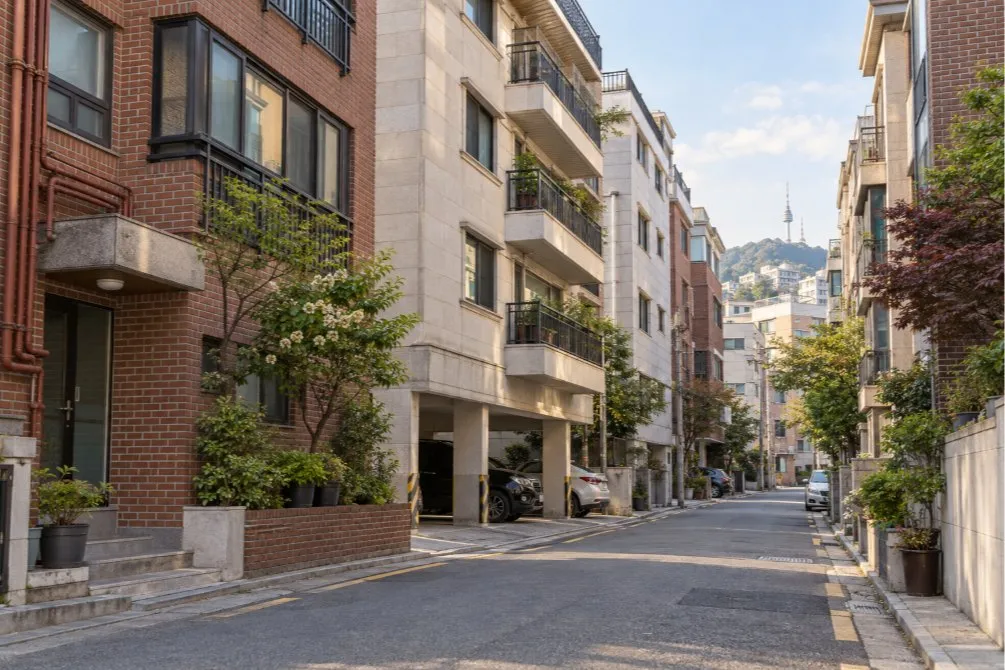
A villa is not a luxury house. It is a low-rise residential building, usually four floors or fewer, where each unit can be owned and sold separately. Villas are cheaper than apartments and often roomier for the price.
The trade-off is information. Villas rarely have reliable public sale prices, which made them the center of Korea’s 2022–2023 jeonse fraud cases, where deposits exceeded what the unit was worth. Always check the property registry and the unit’s real value before paying a large deposit.
Officetels
An officetel (office + hotel) is a compact studio in a building that is legally zoned for business but built for living. They are popular with single workers: modern, secure, often near subway stations, and usually furnished with built-in appliances.
Two things to check:
- Address registration: some officetel landlords register the unit as an office for tax reasons and ask tenants not to register their address there. For a foreign resident, that address report (체류지 변경신고) is what gives you legal protection for your deposit. Do not accept a lease that forbids it.
- Costs: officetel maintenance fees are often higher per m² than apartments, and the usable area is smaller than the listed area suggests.
One-rooms and multi-household houses
Many “one-room” and “two-room” listings are units inside a multi-household house (다가구주택): one owner, one building, many tenants. Each tenant has their own lease, but they share the same building as security. If the owner fails, tenants who registered earlier are paid first. Ask the agent how many tenants are already in the building and the total of their deposits.
Goshiwon and share houses
A goshiwon is a tiny room, sometimes without a window, with a shared kitchen and bathroom. It needs little or no deposit and suits a first few weeks while you search. Share houses are a more comfortable middle option. Neither is a good long-term base if you want your deposit and address fully protected.
Only in Korea In most countries “villa” means a large detached house. In Korea it is a modest walk-up building, a marketing word from the 1980s that stuck. Ask a Korean friend where they live and “villa” will usually mean something smaller than an apartment, not bigger.
Quick checklist
- Match the type to your stay: goshiwon for weeks, one-room or officetel for a year or more
- Confirm you can register your address at the unit
- For villas, compare the deposit with the unit’s real market value
- For multi-household houses, ask about other tenants’ deposits
- Compare the real usable area, not just the listed size
- Ask for the average maintenance fee before signing
This article is general information, not legal advice. Rules and market conditions change; check each listing with a licensed agent. Information as of October 2026.