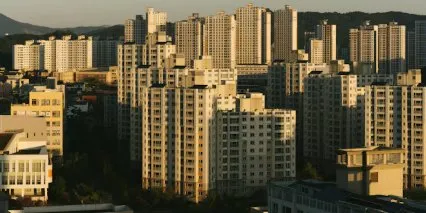
In Korea, how much you can borrow for a home is set less by the bank’s opinion of you and more by government rules. Two ratios decide almost everything: LTV, which limits the loan against the home’s value, and DSR, which limits it against your income. Since 2025 the rules have become much stricter, especially in Seoul.
LTV: how much of the price you can borrow
Loan-to-value (LTV) is the loan as a share of the home’s value.
| Situation | LTV limit (2026) |
|---|---|
| No home, buying in Seoul or another regulated area | 40% |
| First-time buyer in a regulated area | up to 70% |
| Already own a home, regulated area | mostly no mortgage |
All of Seoul and parts of Gyeonggi-do have been regulated areas since October 2025. Outside them, limits are looser.
The cap on top: a fixed maximum loan
In Seoul, the capital region and regulated areas, there is also a hard cap in won, whatever the LTV says:
| Home value | Maximum mortgage |
|---|---|
| Up to ₩1.5 billion | ₩600 million |
| ₩1.5 – 2.5 billion | ₩400 million |
| Over ₩2.5 billion | ₩200 million |
A loan in the capital region also generally requires you to move in within six months. The rules were designed to stop buying with borrowed money for investment.
DSR: how much your income can carry
Debt service ratio (DSR) is the total yearly repayment of all your loans, principal and interest, as a share of your yearly income.
- Banks: 40%
- Non-bank lenders: 50%
With an income of ₩60 million, all your loan payments together can be at most ₩24 million a year at a bank. Car loans, credit loans and student loans all count.
Stress DSR makes this stricter: the bank calculates your repayments as if interest rates were higher than they are, adding a buffer rate. In Seoul and regulated areas the buffer is larger. The result is that you qualify for less than a simple calculation suggests, especially with variable-rate loans.

What rates look like now
Rates have risen in 2026. The average new mortgage rate at Korean banks was 4.66% in August 2026, the highest since late 2022, and fixed-rate loans averaged 4.88%. Our guide to the Bank of Korea rate explains why.
The final loan amount is the lowest of the three limits: LTV, the won cap, and DSR.
What is different for foreign residents
- Commercial banks only: government-backed loans such as Bogeumjari and Didimdol are generally for Korean nationals
- Visa matters: F-5 and F-6 residents get terms closest to Koreans; work visas such as E-7 are reviewed case by case; student visas rarely qualify
- Loan term: banks may limit the loan term to your remaining visa period, which can make monthly payments much higher
- Proof: expect to show your ARC, Korean income records for several months, and a Korean credit history
- Same ratios: there is no separate LTV or DSR for foreigners, but banks may apply stricter internal rules
Buying in Seoul also requires a government permit for foreign buyers in many areas, with a duty to live in the home. See Can foreigners buy property in Korea?
Only in Korea Many Korean buyers barely use mortgages at all. They buy by taking over the tenant’s large jeonse deposit and paying only the difference, which is one reason the government watches deposits and mortgage lending together.
Quick checklist
- Check whether the area is regulated before you plan your budget
- Calculate all three limits: LTV, the won cap, and DSR
- List every existing loan; all of them count toward DSR
- Compare fixed and variable rates under stress DSR
- Ask banks how your visa affects the loan term
- Plan to move in within six months if you borrow in the capital region
This article is general information, not financial advice. Lending rules change often and banks apply their own criteria; confirm with the bank and the Financial Services Commission. Information as of October 2026.