
Owning a home in Korea means dealing with four taxes at different moments: one when you buy, two while you hold, and one when you sell. The good news for foreigners is that the rates are the same as for Koreans. What changes your bill is not your passport but your tax residency and how many homes your household owns.
Here is how each tax works, in the order you will meet them.
1. When you buy: acquisition tax (취득세)
You pay acquisition tax once, within 60 days of buying. It is based on the purchase price.
| Purchase price | Base rate (one home) |
|---|---|
| Up to ₩600 million | 1% |
| ₩600–900 million | Sliding scale between 1% and 3% (about 1.67% at ₩700 million) |
| Over ₩900 million | 3% |
Small add-on taxes (local education tax and, for larger homes, a rural development tax) are charged on top, so the real total is a little higher than the base rate.
The rate jumps if your household will own several homes:
| Homes after purchase | In an adjustment-target area | Elsewhere |
|---|---|---|
| 2 homes | 8% | Base rate |
| 3 homes | 12% | 8% |
| 4 or more | 12% | 12% |
Buying through a company is taxed at 12%.
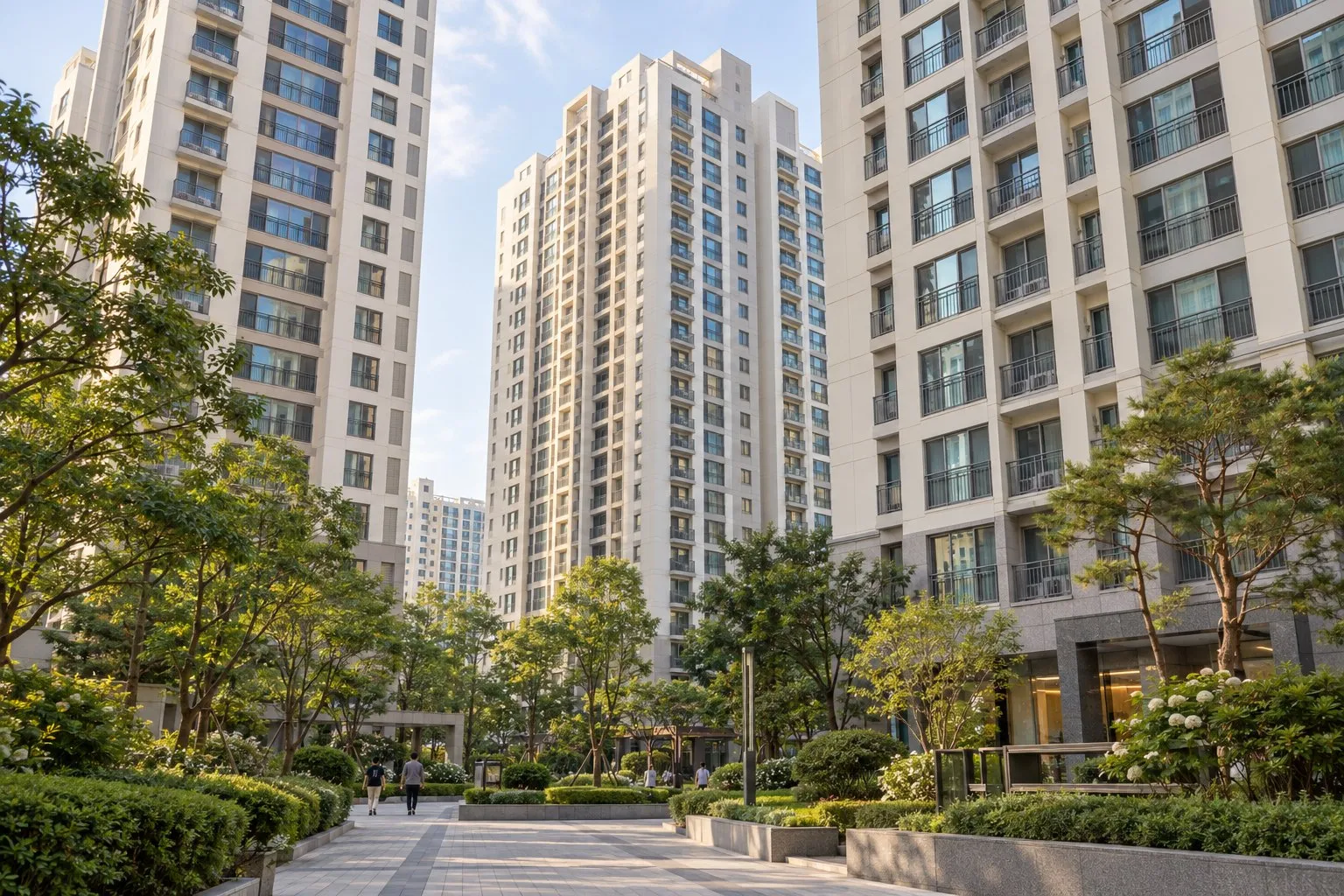
Where are the adjustment-target areas? Since the government’s October 15, 2025 measures, all 25 districts of Seoul plus 12 areas in Gyeonggi Province are designated. These lists change, so check the current map before you sign.
2. Every year: property tax (재산세)
Whoever owns the home on June 1 pays the whole year’s property tax. Bills arrive in two halves:
- July 16–31 — first half
- September 16–30 — second half
The tax is based on the government’s official assessed value (공시가격), not what you paid. Only part of that value is taxed — 43–45% for a household’s only home, 60% for others — and the rate runs from 0.1% to 0.4%. If you own one home assessed at ₩900 million or less, a slightly lower rate applies.
Bills go to your registered address in Korea. If you live abroad, make sure someone can receive them, or check them online on Wetax (wetax.go.kr).
3. Every December: comprehensive real estate tax (종합부동산세)
This second holding tax only hits owners with expensive property. It is also based on what you own on June 1, and it is paid December 1–15.
- You pay only on the assessed value above ₩900 million (all your homes combined).
- If your household owns just one home, the threshold is ₩1.2 billion.
- Rates run from 0.5% to 2.7% for up to two homes, and up to 5.0% for three or more.
Most foreigners who own a single mid-priced apartment will never see this bill. Holding-tax rules are reviewed almost every year, so check the current year’s figures.
4. When you sell: capital gains tax (양도소득세)
This is where residency matters most.
If you are a tax resident — you have an address in Korea or have stayed here 183 days or more — you are treated like a Korean. A household that owns one home for at least two years (and, in adjustment-target areas, lived in it for two years) may pay no capital gains tax on a sale up to ₩1.2 billion. Long-time owners who lived in the home can also deduct up to 80% of the gain.
If you are a non-resident, those breaks mostly disappear:
- The one-home exemption does not apply, with one exception: if your whole household moved abroad for emigration, work or study, you can still use it if you sell within two years of leaving.
- The large 80% deduction is not available. You get only the general deduction (up to 30% after 15 years).
- If the buyer is a company, it withholds part of the price as tax before paying you.
Either way, you must file a return by the end of the second month after the month of sale. The national tax is charged at progressive rates of 6–45%, plus a 10% local income tax on top. Selling within two years costs much more — 70% under one year and 60% under two years for homes.
Multi-home owners: the temporary pause on extra capital gains tax ended on May 9, 2026. Owners of two homes in an adjustment-target area now pay 20 percentage points more, and three or more homes 30 points more, with no long-term deduction.
To send the sale money out of Korea, ask the local tax office for a sale-proceeds confirmation (매각자금 확인서). You can apply within five years of the sale.
Only in Korea: the June 1 closing-date game Because one day decides who pays the whole year’s property tax, Korean buyers and sellers often bargain over the final payment date. Sellers prefer to close before June 1 so the new owner pays; buyers prefer June 2 or later. Some contracts simply split the year’s tax by days instead.
Checklist for foreign owners
- Before buying, count every home your household owns in Korea.
- Check whether the home is in an adjustment-target area.
- Pay acquisition tax within 60 days of buying.
- Mark June 1, July, September and (if it applies) December in your calendar.
- Keep a Korean address or Wetax account so tax bills reach you.
- Before selling, confirm your residency status — it can change the tax by a lot.
- File the capital gains return by the end of the second month after the sale.
- Get a sale-proceeds confirmation before sending money abroad.
Tax treaties between Korea and your home country can also affect how a sale is taxed back home, so talk to a tax adviser who handles both sides.
This article is general information, not legal or tax advice. Figures are as of October 2026 and can change.