Korea's Stock Market Lost Almost Half Its Value: Why a Crash Hurts 14 Million 'Ants'
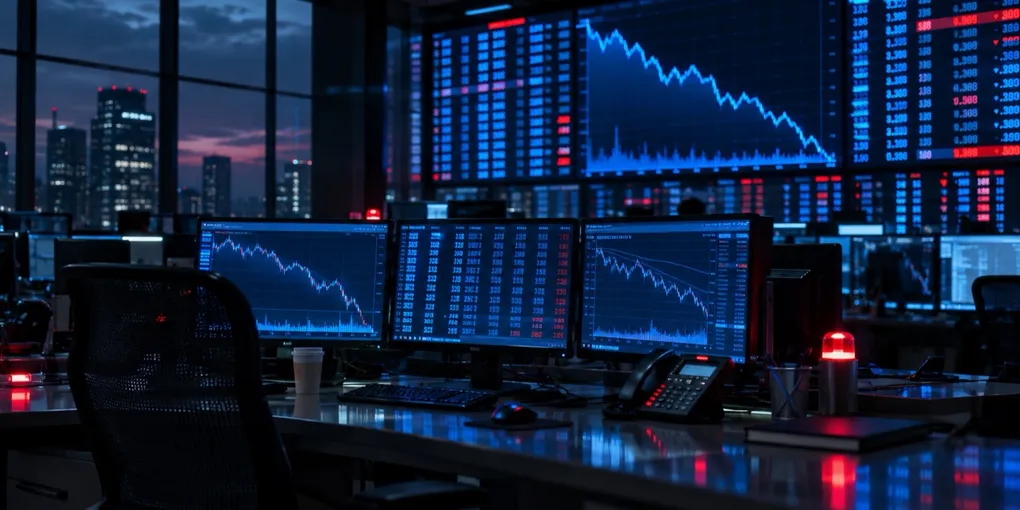
On Monday, November 23, 2026, South Korea’s main stock index, the KOSPI, fell 3.31% and closed at 4,708.54. During the day it dropped as low as 4,586.80, and the exchange had to slow down program selling for the second trading day in a row.[1] Samsung Electronics and SK hynix, the two chip giants that make up a huge part of the market, led the fall after another sell-off in US tech stocks.[2]
The government said it was ready to switch on a stock market stabilization fund of about 10 trillion won (around 7 billion US dollars). Markets were not impressed. The fund was only “ready,” not yet buying, and critics pointed out that it is small next to a market worth thousands of trillions of won.[3][4]
Here is the bigger picture. In June, the KOSPI closed above 9,000 for the first time in history.[5] Five months later, it is close to half of that. For a country where stocks had become a national hobby, that is not just a bad week. It feels personal.
First, a quick color lesson
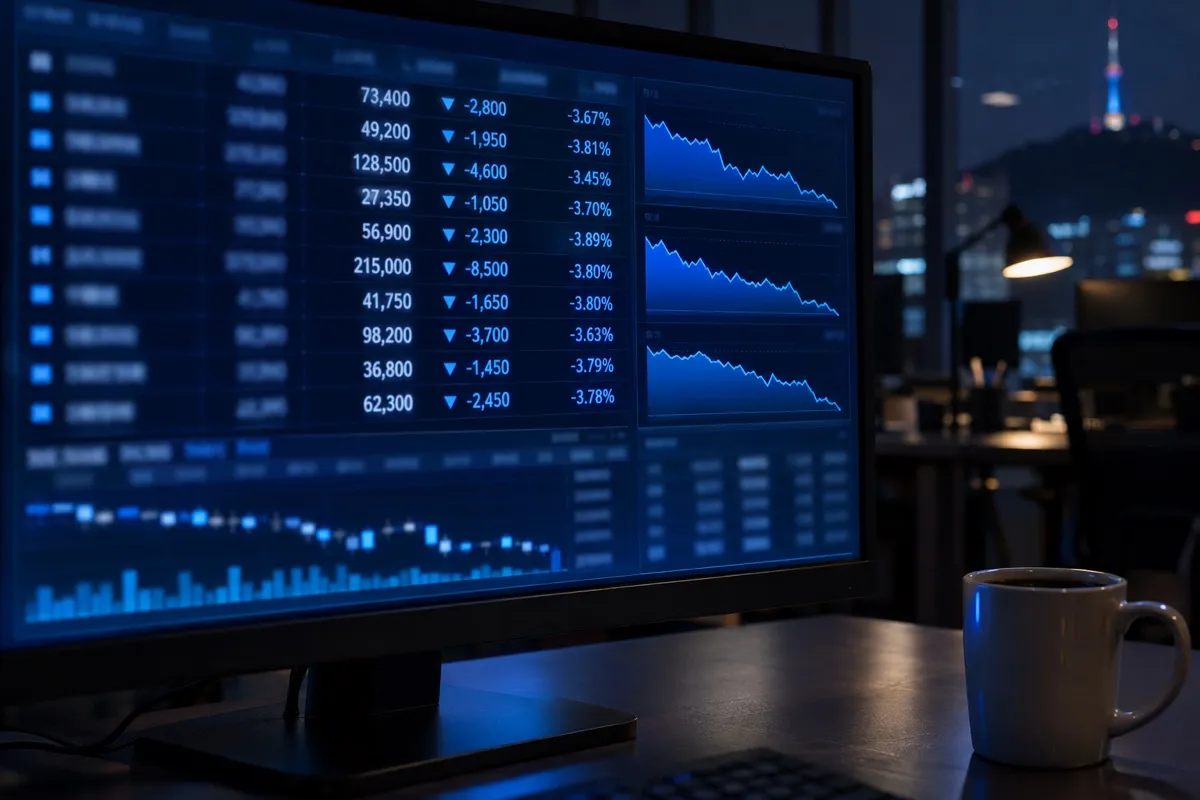
If you open a Korean stock app this week, you might think the market is doing great. Everything is blue. Calm, pleasant blue.
That is a trap for foreigners. In Korea, as in China and Japan, red means up and blue means down, the opposite of Wall Street. So a Korean investor who says “my account is all blue” is not relaxing at the beach. They are having a very bad day.
Who are the “ants”?
Koreans call small individual investors gaemi, “ants.” The word started as a slightly sad joke: tiny, hardworking, and easily stepped on by big foreign funds and institutions.
But the ants are not small as a group. About 14.5 million people in Korea own shares in listed companies, more than one in four people in the whole country.[6] Individuals have long done more than half of the daily trading on the Korean market, far more than in the United States.[7]
Why so many? It connects to an old Korean story. For decades, the safest way to build wealth was an apartment in Seoul. When apartment prices climbed out of reach for young people, many decided the only ladder left was the stock market. Some borrowed to climb it. There is even a word for that: bitu, short for “investing with debt.”
Think of it as the American meme-stock boom of 2021, when millions of people traded GameStop on their phones. Now imagine that energy lasting for years and spreading across the whole country, from university students to retirees.
The problem is the borrowed money
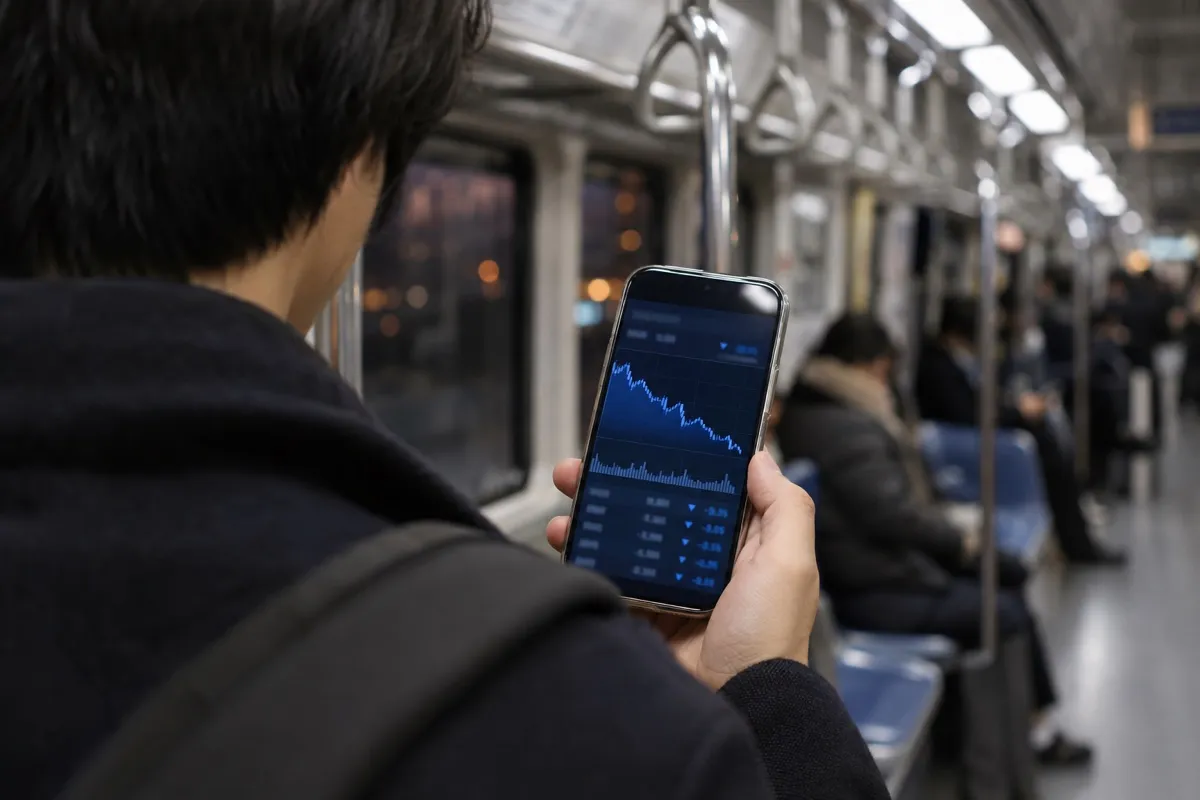
A falling market hurts everyone. A falling market with borrowed money hurts much faster.
In June 2026, the amount Korean investors had borrowed from brokers to buy stocks hit a record of about 38.6 trillion won.[8] When prices fall, brokers can sell a borrower’s shares automatically to get their money back. Koreans call this bandaemaemae, a forced sale. Forced sales push prices lower, which triggers more forced sales. It is a staircase that only goes down.
It got riskier this year. In late May, Korea began allowing funds that bet twice the daily move of a single stock, such as Samsung Electronics or SK hynix. The ants rushed in. When chip stocks fell over the summer, those products lost value very quickly, and the financial watchdog found that investors in them had lost more than 6 trillion won in less than three months.[9][10] Even after that, many kept placing leveraged bets.[10]
So when the KOSPI drops 3% in one day, it is not only a number on the news. For some families, it is a phone call from the broker.
A country that has been here before

To understand why Koreans react so strongly to a market crash, go back to the winter of 1997.
During the Asian financial crisis, South Korea ran out of US dollars and needed a rescue loan from the International Monetary Fund. Big companies went bankrupt and many people lost their jobs. Then something unusual happened. Ordinary people lined up to donate their own gold: wedding rings, baby rings, small gold keys given as gifts. About 3.51 million people gave around 227 tons of gold to help the country pay its debts.[11]
That memory runs deep. Many Koreans still believe the economy is something the whole nation carries together, which is one reason the government feels pressure to “do something” every time the market falls. It is also why a stock crash here gets the kind of attention that a weather disaster gets elsewhere.
But 2026 is not 1997. Korea today is a rich country with large foreign currency reserves. The danger now is not that the nation goes broke. It is that millions of households took on too much risk in a market that depends heavily on two chip companies and on the global AI boom.
What other countries can tell us
The closest warning comes from Japan. In 1989, Japan’s Nikkei index reached a record during a huge stock and property bubble. Then it crashed, and it took 34 years, until February 2024, to climb back above that peak.[12] A whole generation of Japanese savers learned to stay away from stocks.
That does not mean Korea will follow the same path. Markets that fall fast can also recover fast, and nobody can predict which way this one goes. But Japan shows the real cost of a bubble is not only the money lost. It is the trust lost. If a generation of young Koreans decides the stock market was a casino, it will be harder for the country to build the long-term investing culture it has been trying to create.
The ClearLede take
For a thousand years, Koreans have looked for one ladder that could change a family’s life. It used to be the civil service exam. Then a university degree. Then an apartment in Seoul. In the 2020s, for many young people, it became a stock app.
The ladder keeps changing. The pressure does not. When everyone climbs the same ladder at the same time, with borrowed money, the fall is louder.
The lesson of this week is not “stocks are bad.” It is that a country needs more than one ladder.
Speaking only for myself, I would go a step further: I think stocks are a lot like cigarettes. There was a time when smoking was encouraged, and cigarettes sat in pretty vending machines that even children could use. Today the same product carries health warnings on every pack, and governments work hard to cut consumption. So ask the same question about stocks. Are they good for your health, or can they be fatal to it? Korean TV dramas and talk-show experts once called the market a form of gambling dressed up as something legal, and I lean that way too. When the state itself keeps swinging back and forth, cheering people into the market under one government and warning them away under the next, it is hard for Korea’s stock market not to become a gambling table.
Quick facts
- November 23, 2026: KOSPI fell 3.31% to 4,708.54, with an intraday low of 4,586.80.[1]
- The record: The KOSPI first closed above 9,000 on June 18, 2026.[5]
- Government response: A stabilization fund of about 10 trillion won is ready but had not been used as of November 23. Rules on companies buying back their own shares will be eased for three months.[3][4]
- The ants: About 14.5 million individual shareholders.[6]
- Borrowed money: Margin loans hit a record of about 38.6 trillion won in June 2026.[8]
If money worries are affecting your mental health, please talk to someone. In Korea, call 109 (suicide prevention hotline, 24 hours). Outside Korea, contact your local emergency number or crisis line.
This is commentary based on news reports. It is not investment advice, and ClearLede does not recommend buying or selling any stock. Facts and figures are as of November 23, 2026, and markets can change quickly.
Sources
- Businesskorea, “KOSPI plunges 3.3% on joint selling by foreigners and individuals, barely holding 4,700” (Korean), November 23, 2026. https://www.businesskorea.co.kr/news/articleView.html?idxno=281954
- Korea JoongAng Daily, “Kospi slips 3.3% as AI stock sell-off hits Samsung, SK hynix,” November 23, 2026. https://www.koreajoongangdaily.com/business/kospi-slips-33-as-ai-stock-selloff-hits-samsung-sk-hynix/12986396
- Segye Ilbo, “Even with the stabilization fund card, KOSPI slips back to early-year levels” (Korean), November 23, 2026. https://www.segye.com/newsView/20261123515104
- Nate News, “KOSPI breaks below 4,600 intraday; government says it is preparing the stabilization fund” (Korean), November 23, 2026. https://m.news.nate.com/view/20261123n29711
- Digital Daily, “KOSPI closes above 9,000 for the first time” (Korean), June 18, 2026. https://www.ddaily.co.kr/page/view/2026061816271684390
- Asia Economy, “The Era of 14.56 Million Shareholders of Listed Companies,” March 18, 2026. https://view.asiae.co.kr/en/article/2026031809540784827
- The Korea Times, “Retail investors take up 64% of Korean stock market,” November 14, 2023. https://www.koreatimes.co.kr/economy/20231114/retail-investors-take-up-64-of-korean-stock-market
- Financial News, “Volatility at a peak, yet debt-financed investing soars; forced sales top 50 billion won a day” (Korean), June 30, 2026. https://www.fnnews.com/news/202606301535074321
- The Korea Times, “Leveraged ETF fiasco weighs on Lee administration’s economic team,” July 30, 2026. https://koreatimes.co.kr/economy/20260730/leveraged-etf-fiasco-weighs-on-lee-administrations-economic-team
- Korea JoongAng Daily, “Just can’t quit you: Korean retail investors still placing leveraged bets despite near wipeouts,” 2026. https://www.koreajoongangdaily.com/business/just-cant-quit-younbspkorean-retail-investors-still-placing-leveraged-bets-despite-near-wipeouts/12966125
- Korea.kr (Government of the Republic of Korea), policy briefing on the 1998 gold-collecting campaign (Korean). https://www.korea.kr/briefing/policyBriefingView.do?newsId=148738240
- Bloomberg, “Nikkei Overtakes 1989 High to Hit Record as Global Funds Pour In,” February 22, 2024. https://www.bloomberg.com/news/articles/2024-02-22/nikkei-225-heads-to-close-above-record-high-reached-in-1989