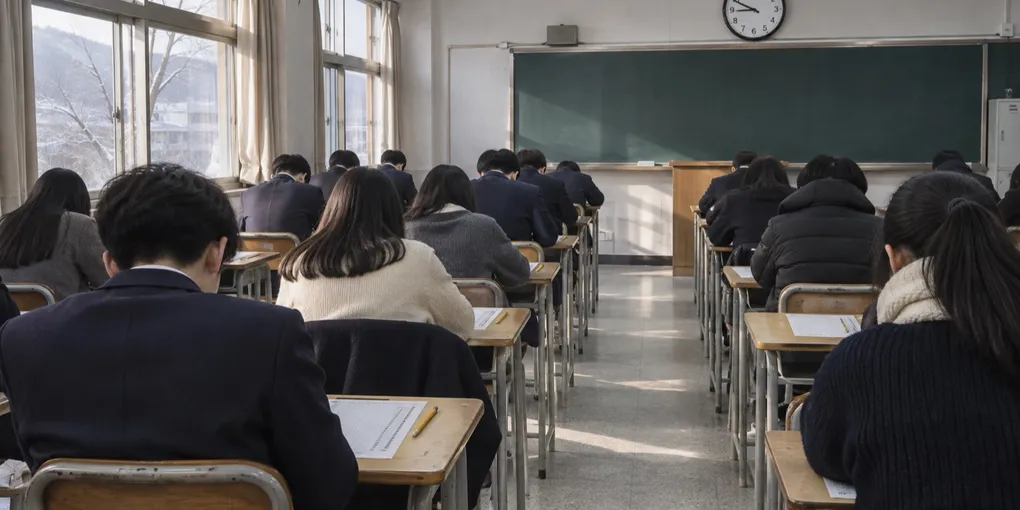
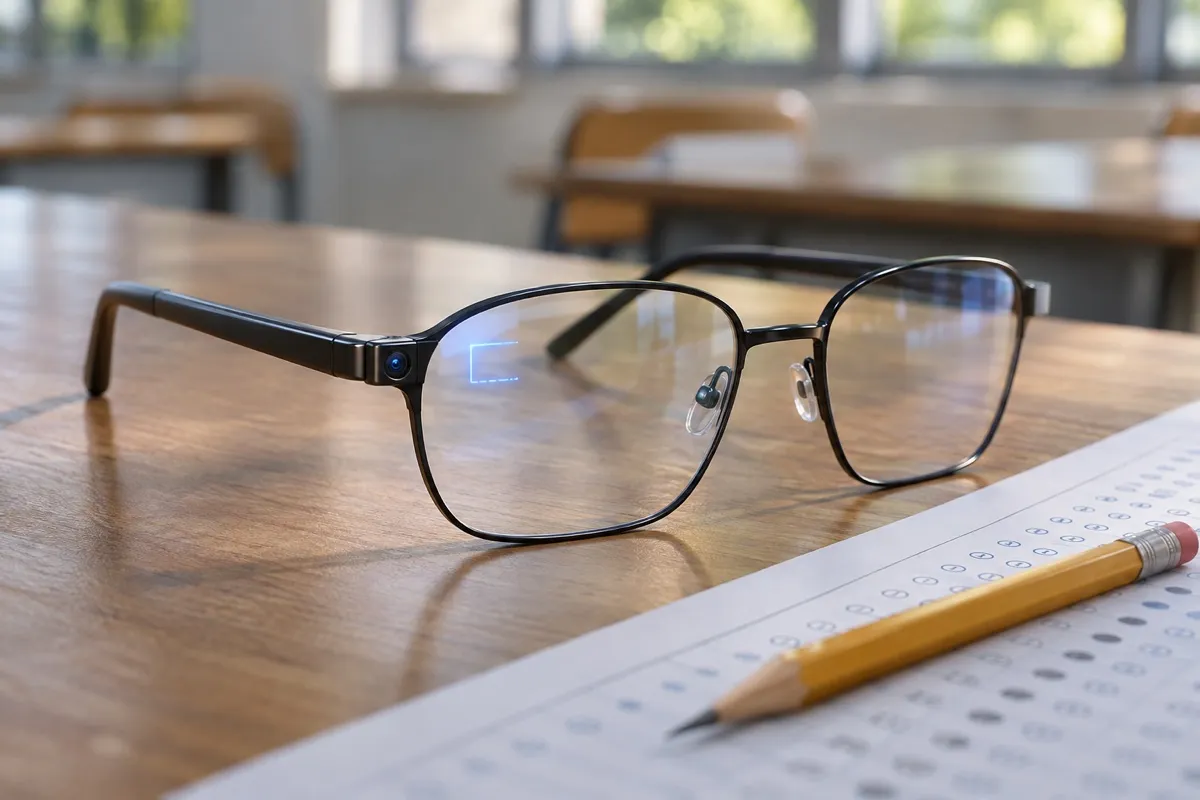
In October 2026, a proctor at Yonsei University, one of Seoul’s top three universities, looked at a student’s face during a math essay exam and noticed something odd about the student’s glasses. They were not the same pair the student had worn at check-in. They were AI smart glasses.[1] A week earlier, the same thing had happened at the University of Seoul.[1]
Then it got bigger. In November, the top scorer on South Korea’s national tax accountant exam confessed that he had used a hidden micro-camera and a generative AI tool to get his score.[2][3] The president’s office ordered a review of AI cheating across national exams, days before the country’s biggest test of the year.[3] By the time 551,864 students sat the college entrance exam on November 19, every test site had a supervisor trained to spot smart glasses.[4]
The verdict from the exam itself: 111 cases of cheating with electronic devices were caught, and one of them involved smart glasses.[5] One pair of glasses out of half a million students sounds small. But the government is already talking about tripling the ban for cheaters and even about changing the whole exam system.[4][5]
So why does a gadget make a whole country nervous? Because in Korea, an exam is never just an exam.
The gadget is new. The temptation is 1,000 years old.
Korea started choosing government officials by written exam in 958, under King Gwangjong of the Goryeo dynasty, borrowing the idea from imperial China. The exam, called gwageo, lasted until 1894. That is more than 900 years of one simple rule: pass the test, and your family moves up. Fail, and it doesn’t.
Where there was a test, there was cheating. Records from the Joseon dynasty (1392–1910) describe candidates hiding tiny paper notes covered in bean-sized characters on their bodies, a trick the records call hyeopseo, “carrying writing in.”[6] Others paid someone else to write their answers, called chasul, “borrowed writing.”[7] In 1586, a famous writer named Cha Cheon-ro was exiled after it came out that he had written a friend’s exam answer, which won first place.[8] In 1677, an exam was cancelled outright after cheating in its final round.[9] In the late Joseon period, exam halls were so crowded with hired servants and stand-in test takers fighting for good seats that order often broke down.[6]
Swap the bean-sized paper for a camera in a glasses frame, and the story writes itself. The technology changed. The pressure didn’t.
If you are from the West, think of the 2019 “Varsity Blues” scandal in the United States, where wealthy parents paid to fake test scores and sports records to get their kids into elite universities.[10] Now imagine that the whole country, not just a few rich families, felt that kind of pressure, every year, for every child. That is closer to Korea.
Why Koreans feel they have no choice but to study

Here is the part foreigners usually miss. Koreans don’t study this hard because they love exams. They study because, for most families, the exam is the only ladder they trust.
Korea is a small country with almost no natural resources. For decades after the Korean War, education was the one investment a poor family could make that nobody could take away. It worked. A generation of farmers’ children became engineers, doctors and civil servants, and the country became rich.
But a ladder that worked for everyone in the 1970s now feels much narrower. Today, a degree from one of the “SKY” universities (Seoul National, Korea and Yonsei) still opens doors to the best jobs, and the alumni networks of those schools stay strong for a lifetime. When the reward at the top is that large, the competition to get there becomes endless.
You can see it in the money. In 2025, Korean families spent about 27.5 trillion won (roughly 19 billion US dollars) on private tutoring for school-age children. Spending per student who took private lessons hit a record of 604,000 won a month (about 420 dollars).[11] Many children go from school straight to a hagwon, a private cram school, and come home after 10 p.m.
A useful comparison: China’s gaokao and the old British “11-plus” exam both sorted children at a young age, too. The difference in Korea is scale and duration. The sorting starts in elementary school and doesn’t really stop until the first job offer.
Only in Korea: On the day of the college entrance exam, called Suneung, the country changes its schedule for teenagers. Government offices and many companies start work after 10 a.m. to keep the roads clear. During the English listening section, no plane may take off or land anywhere in Korea. In 2026, that meant 130 flights were rescheduled for about 35 minutes of silence.[15] Younger students line up outside test sites to cheer for their seniors, and police cars give late test takers a ride.
What happens to the kids who lose
Every race has people who finish last. In Korea, the worry is that some children lose twice: they fall behind in school, and they lose their friends and their place along the way, because so much of teenage life happens inside the competition.
The numbers are hard to read. Suicide has been the leading cause of death for Koreans aged 9 to 24 for 14 years in a row.[12] In 2025, even as the national suicide rate fell, the rate among school-age children reached a record high.[13] In the first national survey of socially withdrawn young people, released in 2025, about 62 percent of respondents said they had thought about suicide.[14]
Not every young person who struggles ends up this way, and exams are not the only cause. But when a society tells children that one test equals one life, the children who fail that test can start to believe they have failed at life. Some turn inward and stop leaving their rooms. Some give up. And a few, as this month showed, look for a shortcut, even an illegal one.
What this scandal really tells us
It would be easy to treat the AI glasses story as a tech story: new gadget, new rules, a radio detector at the exam door. Korea is already doing that.[4] But the more interesting lesson is about trust.
Korea’s exam system is harsh, but for many Koreans it has one great virtue: it feels fair. Rich or poor, everyone sits the same test on the same day, in silence, with the same pencil. That shared belief is why a cheating case shocks the country far more than it would in many other places. It isn’t only about one student. It is a crack in the one system people still believe treats them equally.
AI glasses put that belief under pressure from a new direction. If a machine can answer every question, as one YouTuber showed when his AI glasses solved all 160 questions from this year’s tax accountant first-round exam,[2] then the question is no longer just “How do we catch cheaters?” It is “What is this exam actually measuring?” That is why some Koreans are now arguing for more essay-style school assessments, or even for turning the entrance exam into a simple pass-or-fail qualification test.[5]
That debate is not only Korean. Schools in the US, the UK and China are all asking the same thing about AI. Korea just feels it first and feels it hardest, because it has bet the most on exams for the longest time.
The ClearLede take
If you want to understand Korea, don’t start with the gadget. Start with the parent waiting outside the exam gate on a cold November morning. That parent isn’t asking their child to be a genius. They are asking for the one thing their country has rewarded for a thousand years: pass the test, and you’ll be safe.
The real challenge for Korea is not stopping one pair of glasses. It is building a society where a teenager who fails one exam still has a good second road to take. Until then, someone will always be tempted by the shortcut, whether it is a bean-sized note in a sleeve in 1700 or a camera in a frame in 2026.
Quick facts
- What happened: AI smart glasses were caught in university essay exams at Yonsei and the University of Seoul (October 2026), and the top scorer of the national tax accountant exam confessed to using a hidden camera and AI (November 2026).[1][2]
- The penalty now: Using AI glasses during the Suneung voids the test and bars the student from the next year’s exam. The government is pushing to extend the ban to three years.[4][5]
- The 2027 Suneung (November 19, 2026): 111 electronic-device cheating cases, one involving smart glasses.[5]
- The big debate: more essay-based assessment, or turning the Suneung into a pass-or-fail exam.[5]
If you or someone you know is struggling, help is available. In Korea, call 109 (suicide prevention hotline, 24 hours). Outside Korea, contact your local emergency number or crisis line.
This is commentary based on news reports, not legal advice. Facts and figures are as of November 22, 2026, and may change as investigations continue.
Sources
- Kyunghyang Weekly, “Smart glasses caught at Yonsei University essay exam” (Korean), October 13, 2026. https://weekly.khan.co.kr/article/202610131916001
- Korea JoongAng Daily, “AI cheating confession puts Korea’s exams under scrutiny ahead of CSAT,” November 2026. https://www.koreajoongangdaily.com/korea/ai-cheating-confession-puts-koreas-exams-under-scrutiny-ahead-of-csat/12974040
- South China Morning Post, “Top tax accountant exam scorer in South Korea admits using AI to cheat,” November 2026. https://www.scmp.com/news/asia/east-asia/article/3374467/top-tax-accountant-exam-scorer-south-korea-admits-using-ai-cheat
- CNN, “South Korea to inspect all exam takers’ glasses following AI cheating scandal,” November 16, 2026. https://www.cnn.com/2026/11/16/asia/south-korea-ai-glasses-cheating-intl-hnk
- Financial News, “Smart glasses cheating sparks calls to overhaul the Suneung” (Korean), November 22, 2026. https://www.fnnews.com/news/202611220842539862
- Kyongbuk Maeil, column on cheating in the Joseon civil service exam (Korean), November 17, 2026. https://kbmaeil.com/article/20261117500427
- Hangyo, “Cheating in the gwageo exam” (Korean). https://hangyo.com/mobile/article.html?no=24040
- Law Times, column on exam cheating in Joseon (Korean). https://www.lawtimes.co.kr/opinion/188684
- Jeon Kyung-mok, academic paper on the 1677 jeunggwangsi exam (Korean), Korean Studies Quarterly 34(3). https://accesson.kr/ksq/assets/pdf/40794/journal-34-3-28.pdf
- U.S. Department of Justice, “Investigations of College Admissions and Testing Bribery Scheme” (Operation Varsity Blues). https://www.justice.gov/usao-ma/investigations-college-admissions-and-testing-bribery-scheme
- Newsis, “Total private education spending falls for the first time in five years: 27.5 trillion won” (Korean), March 12, 2026. https://www.newsis.com/view/NISX20260312_0003545284
- The Korea Times, “Suicide remains top cause of death among Korean youth for 14th straight year,” May 22, 2026. https://www.koreatimes.co.kr/southkorea/society/20260522/suicide-remains-top-cause-of-death-among-korean-youth-for-14th-straight-year
- Asia News Network, “South Korea’s suicide crisis may be easing. For teens, it isn’t.” https://asianews.network/?p=309404
- The Korea Times, “60% of reclusive youth in Korea have considered suicide: survey,” March 25, 2025. https://www.koreatimes.co.kr/amp/southkorea/society/20250325/60-of-reclusive-youth-in-korea-have-considered-suicide-survey
- Korea.kr (Government of the Republic of Korea), Ministry of Land, Infrastructure and Transport press release on flight control during the 2027 Suneung listening test (Korean), 2026. https://m.korea.kr/briefing/pressReleaseView.do?newsId=156789540