
A Korean bank account is needed for your salary, rent, phone bill and most app payments. The process is simple once you know what the bank will ask for. Most problems come from missing paperwork, not from being a foreigner.
Who can open an account?
Short answer: almost anyone can open some kind of account, but people with a residence card get the most options.
Korean banks sort foreigners roughly into two groups. Local government guidance treats someone who has stayed in Korea for more than six months as a resident and someone who has stayed for less as a non-resident.
If you have a residence card. The card used to be called the Alien Registration Card (ARC). With it you can open a regular account, get a debit card and set up mobile banking. Since January 2025 the Ministry of Justice has also issued a mobile version of the card. Some banks accept it for account opening if your smartphone is registered in your own name.
If you only have a passport. Banks may still open an account using your passport. Guidance from KOTRA’s foreign investment ombudsman says that without a residence card you should also bring proof of where you live in Korea, such as a utility bill or a hotel booking. Expect a restricted account, and do not count on online banking. Each branch decides, so call ahead.
If you just arrived on a long-term visa, it is often easier to wait until your residence card is issued.
What documents do you need?

The bank needs to know who you are and why you want the account. The second part is called the purpose-of-transaction check (금융거래목적 확인, a check on what the account will be used for). It was introduced to stop scam accounts, and Korean citizens go through it too.
| Document | Who needs it | Notes |
|---|---|---|
| Residence card (or mobile residence card) | Registered foreigners | Bring the original, not a photo |
| Passport | Everyone | Required alongside or instead of the residence card |
| Korean phone number | Strongly recommended | App sign-up and text verification usually need a number in your own name |
| Proof of purpose | Everyone | See below |
| Proof of address | Passport-only applicants | Utility bill or hotel booking |
Proof of purpose depends on why you want the account. KB Kookmin Bank’s guidance lists these examples:
- Salary: employment certificate (재직증명서), tax withholding receipt or health insurance certificate
- Part-time job: employment contract plus your employer’s business registration copy
- Bills: utility or apartment maintenance fee receipts
- Study: an admission letter and student visa. Many students bring an enrollment certificate (재학증명서) from their school as well.
The bank may ask for more. If you are renting, your lease contract can also help. Our guide on renting an apartment in Korea explains what that contract looks like.
What is a limited-transaction account?
If you cannot prove the purpose, the bank may still open a limited-transaction account (한도제한계좌, an account with daily caps on withdrawals and transfers). This is very common for newcomers.
The Financial Services Commission raised the caps from May 2, 2024. Current limits per day are:
- Bank counter: ₩3,000,000
- ATM: ₩1,000,000
- Internet and mobile banking transfers: ₩1,000,000
Accounts that existed before that date were moved to the new limits automatically. You can hold only one limited account per bank. Individual banks can still set their own rules within this framework. For example, Toss Bank says new foreign customers start with a ₩300,000 daily transfer limit.
How to lift the limit: bring the right purpose document (an employment certificate, for example) to a branch and ask them to remove the restriction. Some banks let you upload documents in the app instead. Toss Bank says its review takes two to three business days. Some banks also lift limits automatically after a period of regular salary deposits. Ask your branch which option it offers.
Which banks are easiest for foreigners?
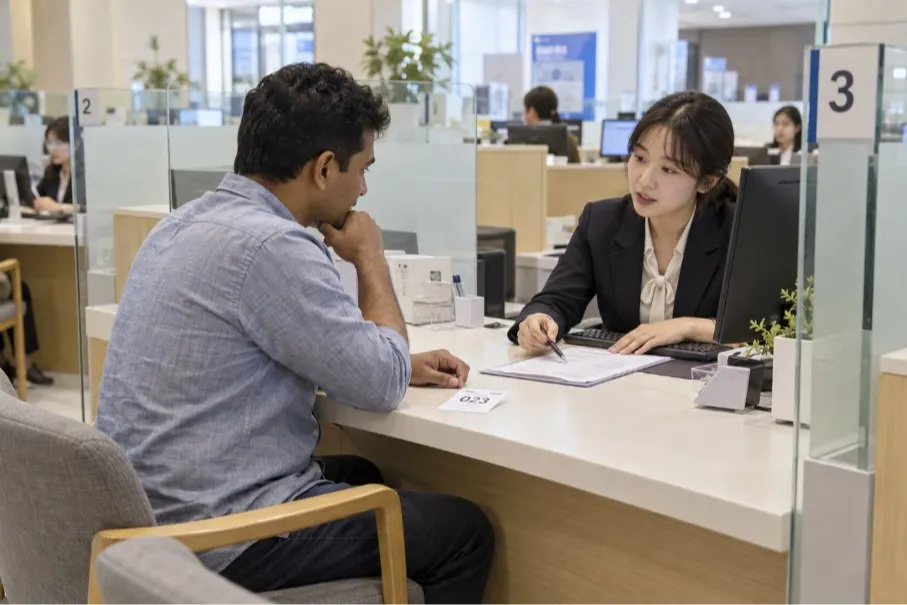
All the big commercial banks open accounts for foreigners: KB Kookmin, Shinhan, Hana, Woori and NH Nonghyup. The real difference is how much help you get.
- Sunday branches. Several banks open selected branches on Sundays in areas with many foreign residents. Hana Bank runs about 17 of them, the most of any Korean bank. Shinhan opened Sunday service at its Dongdaemun, Suwon Station and Onyang (Asan) branches in July 2025, from 10 a.m. to 3 p.m. Its Ansan foreigner branch also opens on Sundays. KB Kookmin, Woori and IBK run Sunday branches in Ansan as well.
- Foreigner apps. Hana’s Hana EZ app and Shinhan’s foreigner app offer several languages. Shinhan’s app supports 16.
If you work weekdays, a Sunday branch with interpreters can save you a lot of trouble.
Can foreigners use KakaoBank, Toss Bank or K bank?
This is changing quickly. Here is the situation as of early October 2026:
- Toss Bank: Yes. Foreigners with a residence card, permanent residence card or domestic residence report certificate can open an account in the app. You must be 14 or older. You can get a debit card and savings products, but not unsecured loans.
- KakaoBank: Not yet. Its main account products are still limited to Korean nationals. The bank has said it plans to offer accounts, debit cards and remittance for foreign residents in the fourth quarter of 2026.
- K bank: In September 2026 it removed the nationality wording from its account terms. Its app-based account opening for foreigners was still being prepared at that time.
Internet-only banks have no branches, so you will need your residence card for app-based ID checks.
Debit cards, app setup and security
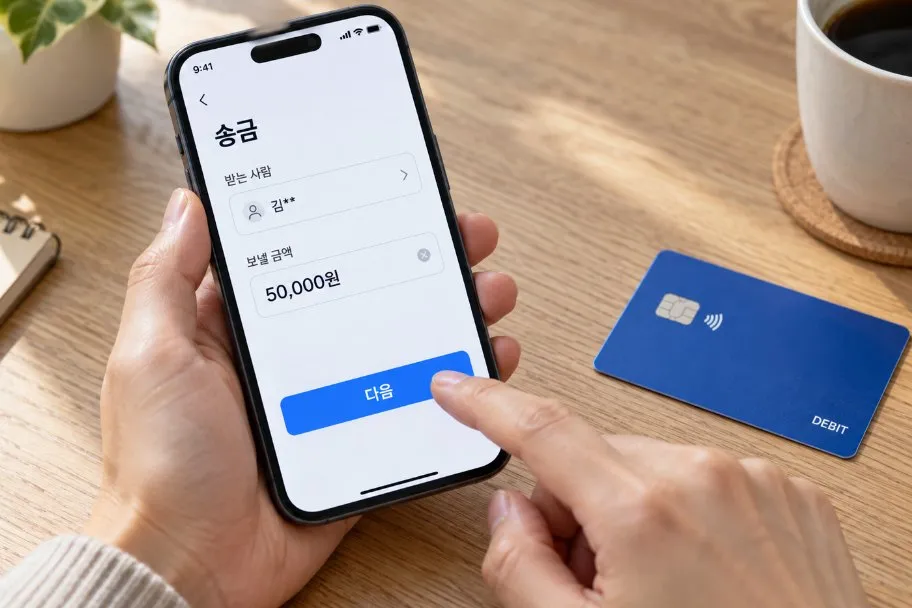
Most foreigners use a debit card (체크카드, a “check card” linked directly to your account). Ask for one when you open the account; you can often use it right away or within a few days. Credit cards are harder to get without a credit history in Korea.
For mobile banking, the branch will help you register for internet banking. You then install the bank’s app and verify yourself with your phone number. If the name on your phone contract does not match your bank record, verification can fail. Check this before you go.
To send larger transfers, banks ask for an extra security step, usually a one-time password (OTP). This may be a mobile OTP inside the app or a small physical device. Ask which one the branch recommends. Never share OTP codes or your banking password with anyone, including people who say they are from the bank.
Fees vary by bank, and they change. Common charges include ATM withdrawals outside business hours, transfers through other banks’ ATMs and overseas remittances. Ask the branch for its current fee list.
Practical tips
- Match your name exactly. The spelling on your residence card, phone contract and bank record should be identical, including spaces and name order. This is the most common reason app verification fails.
- Bring help. A Korean-speaking friend or coworker can make the visit faster. Otherwise, choose a foreigner-focused or Sunday branch with interpreters.
- Ask about limits on the spot. Before you leave, ask whether the account is limited and what document would lift the limit.
Summary
With a residence card, a Korean phone number in your name and proof of purpose, you can open a full account in one visit. With missing documents you will likely get a limited account. You can upgrade it later. Passport-only visitors can sometimes open a basic account, but rules differ by branch.
Only in Korea
Until 1993, Koreans could legally open bank accounts under made-up names or no name at all. On the evening of August 12, 1993, President Kim Young-sam introduced the real-name financial transaction system by presidential emergency order, without passing a new law first. From the next day, every bank transaction had to use the account holder’s real name. That is why Korean banks still check your ID so carefully.
The limited-transaction account dates back to 2016. Financial authorities created it to fight “borrowed-name bankbooks” (대포통장), accounts opened in one person’s name but used by criminals such as voice-phishing gangs to move stolen money. Capping daily transfers on accounts with no proven purpose made them much less useful to scammers.
Checklist
- Residence card (or mobile card) and passport
- Korean phone number in your own name
- Proof of purpose: employment certificate, enrollment certificate or utility bill
- Name spelled the same on every document
- Ask for a debit card and internet banking
- Set up the app and OTP before leaving
- Ask how to lift transaction limits
This article is general information, not financial or legal advice. Bank rules change; check with your bank. As of October 2026.